
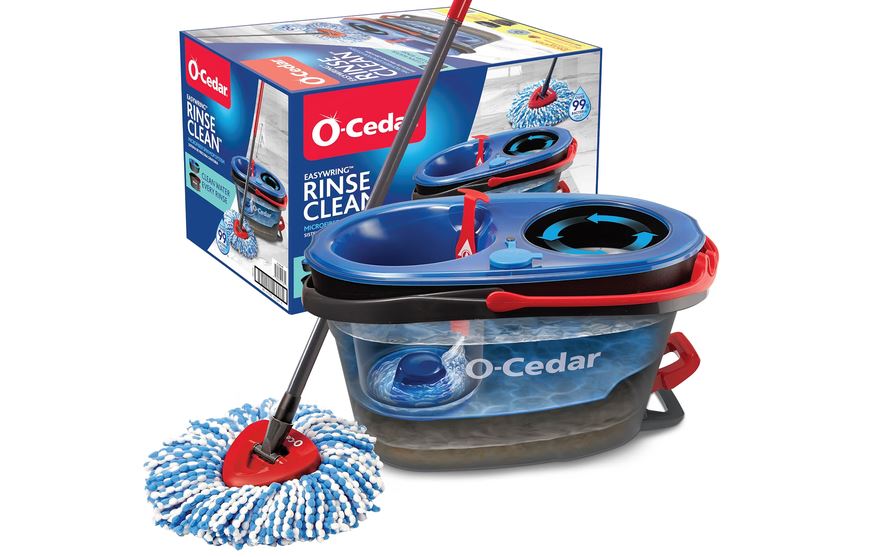
The O-Cedar RinseClean Spin Mop & Two-Bucket System takes the basic idea behind a traditional spin mop and addresses one of its biggest limitations: repeatedly rinsing a dirty mop in the same water you are using to clean your floors.
Its defining feature is the two-bucket design. One compartment holds clean water while the other collects the dirty water removed from the mop. The system also retains O-Cedar’s foot-activated spinning wringer, allowing you to remove excess moisture without touching the mop head.
On paper, this sounds like a straightforward improvement over a conventional spin mop. But does the RinseClean actually make floor cleaning better, or does the more complicated bucket create problems of its own?
The RinseClean is a compelling option for people who frequently mop hard floors and specifically want clean and dirty water separated. However, its larger and more complicated bucket system isn’t automatically better for every household. Current customer reviews show strong satisfaction overall, but also recurring complaints involving the size of the mop head, handle, water capacity and wringing experience.
This review looks at how the RinseClean works, what makes it different from the EasyWring, its cleaning performance, maintenance, customer feedback, potential drawbacks and the types of households that are most likely to benefit from it.
O-Cedar RinseClean Spin Mop at a Glance
| Feature | O-Cedar RinseClean |
|---|---|
| Mop type | Spin mop and two-bucket system |
| Water system | Separate clean and dirty water compartments |
| Wringing | Foot-activated |
| Mop head | Reusable microfiber |
| Head shape | Triangular |
| Handle | Telescoping |
| Maximum handle length | 51 inches |
| Clean/dirty water separation | Yes |
| Mop head | Machine washable |
| Electricity required | No |
| Batteries required | No |
| Compatible surfaces | Sealed hardwood, tile, laminate and vinyl |
| Main advantage | Mop with clean water during the cleaning process |
| Main limitation | More complex and bulky than a basic mop system |
| Best for | Frequent mopping and high-traffic floors |
O-Cedar describes RinseClean as a two-tank spin-mop system designed to separate clean and dirty water. It retains the foot-activated wringer and includes a reusable microfiber mop head and a telescoping handle extending to 51 inches.
What Is the O-Cedar RinseClean Spin Mop?
The RinseClean is essentially O-Cedar’s answer to a common problem with conventional mop-and-bucket systems.
With a conventional single-bucket mop, you dip a dirty mop head back into the same water repeatedly. As cleaning continues, the water becomes increasingly contaminated with the dirt you’ve removed from the floor.
The RinseClean uses a different approach.
Its top blue compartment stores clean water, while the lower portion collects water removed from the mop during wringing. O-Cedar says the design allows you to repeatedly rinse the mop using clean water rather than returning it to the same dirty water.
The system also includes the familiar foot pedal.
So the basic cleaning cycle is:
Clean water → mop → rinse → wring → dirty water collected → repeat.
That is the fundamental reason to choose RinseClean over the standard EasyWring.
How Does the O-Cedar RinseClean Work?
The system looks more complicated than a conventional mop bucket, but the basic process is relatively simple.
1. Fill the clean-water compartment
Water is added through the opening in the upper blue tank.
O-Cedar’s instructions explain that opening the red valve allows the clean water to flow into the appropriate compartment.
2. Wet the mop head
Dip the microfiber head into the clean-water compartment.
3. Mop the floor
Use the triangular microfiber head to clean the floor.
4. Return the mop to the rinse area
When the mop head becomes dirty or needs more moisture, place it back into the clean-water compartment.
5. Wring the mop
Move the mop head into the wringer and press the foot pedal.
The spinning action removes excess water.
6. Dirty water goes into the lower compartment
The water removed during wringing is directed into the lower portion of the system.
O-Cedar describes this as the mechanism that keeps the clean and dirty water separated.
7. Continue cleaning
Repeat the process as necessary.
When finished, the upper tank can be removed and the dirty water emptied.
The Main Feature: Two-Bucket Water Separation
This is where the RinseClean differs most significantly from the O-Cedar EasyWring.
The EasyWring uses a conventional single-bucket system.
RinseClean separates the water.
O-Cedar’s current comparison material describes the RinseClean as a dual-bucket spin-mop system designed for everyday deep cleaning where clean-water separation is a priority.
Why does that matter?
Imagine cleaning a kitchen floor after a busy week.
Your mop picks up:
- food residue
- dust
- grease
- dirt
- pet-related messes
- general household grime
With a traditional single-bucket system, you repeatedly rinse that mop in the same bucket.
With RinseClean, the manufacturer designed the system so that the clean-water supply and water removed during wringing are separated.
That doesn’t magically make the floor clean.
But it changes the cleaning process.
And for people who dislike the idea of repeatedly putting a dirty mop into increasingly dirty water, that difference may be meaningful.
Does RinseClean Really Keep Clean and Dirty Water Separate?
That is the design objective, and O-Cedar states that the system completely separates the two. The company’s instructions explain that the upper compartment holds clean water while the lower compartment receives dirty water during wringing.
However, an independent review should also acknowledge that some customers have questioned how effectively the system works in practice.
For example, a Walmart reviewer reported concerns about the relationship between the clean-water reservoir and the lower compartment, while another reviewer praised the system specifically because it kept water used for pet accidents from becoming part of the cleaning process.
These are individual customer experiences rather than laboratory findings, so they shouldn’t be treated as proof that the system is defective.
The useful takeaway is this:
The RinseClean’s two-water design is its primary reason to buy it, but the actual user experience can depend on how the system is filled, rinsed, wrung and maintained.
Foot-Pedal Wringing
RinseClean retains one of O-Cedar’s most recognizable features: the foot-activated wringer.
Instead of grabbing the wet mop head and squeezing it manually, you place the head in the wringer and press the pedal.
O-Cedar says the pedal allows you to control the moisture level of the mop. Its current instructions recommend pumping the pedal several times while holding the handle loosely.
This is useful because different floors and cleaning situations may require different moisture levels.
A heavily saturated mop isn’t always desirable.
By spinning the mop longer, you can remove more water before returning to the floor.
Does the Foot Pedal Work Well?
Customer feedback is generally positive about the spinning mechanism.
Lowe’s current review summary describes the spin mechanism as easy to use and effective at wringing the mop, while many customers praise the system’s convenience.
However, there are exceptions.
A recent Lowe’s reviewer reported that the mop remained too wet even after repeatedly using the pedal and said they still needed to wring it by hand. Other reviews mention problems with the mop head or handle rather than the basic spinning concept itself.
So the fair assessment is:
The foot wringer is one of RinseClean’s strongest features, but individual experiences with wringing performance aren’t completely consistent.
RinseClean Microfiber Mop Head
The RinseClean uses a triangular microfiber mop head.
O-Cedar says the RinseClean’s red triangular frame is smaller than the EasyWring’s, while the microfiber strings are longer to maintain cleaning performance and improve maneuverability in tight spaces.
The triangular design can be useful for:
- corners
- edges
- around furniture
- narrow areas
- ordinary hard-floor cleaning
The mop head is also washable and reusable.
O-Cedar recommends machine- or hand-washing the microfiber head and avoiding bleach and fabric softener.
Is the Smaller Mop Head a Problem?
This is one of the more interesting issues in the customer feedback.
Some customers appreciate the maneuverability.
Others think the mop head is simply too small.
Current Lowe’s feedback includes complaints about the mop head being too small, while some Walmart reviewers describe the mop as easy to maneuver and effective.
That suggests this is partly a matter of cleaning style.
If you value:
maneuverability → the smaller triangular head can be useful.
If you want:
maximum floor coverage per pass → the smaller head may feel slow.
This is an important distinction that isn’t obvious from the manufacturer’s product description.
Is the O-Cedar RinseClean Good for Hardwood Floors?
Yes, it is designed for common sealed hard-floor surfaces, including sealed hardwood.
O-Cedar specifically lists:
- sealed hardwood
- sealed wood
- tile
- laminate
- vinyl
among compatible floor surfaces.
The ability to control moisture is particularly relevant to wood flooring.
However, “safe for hardwood” should not be interpreted as “safe for every wood floor under every condition.”
Always follow the flooring manufacturer’s cleaning instructions, particularly for unfinished, damaged or unusually sensitive wood surfaces.
RinseClean on Tile Floors
Tile is one of the surfaces where a mop such as RinseClean can make practical sense.
Tile floors can accumulate:
- dust
- food particles
- spills
- grime
- footprints
- pet messes
The microfiber head can handle routine surface cleaning, while the foot wringer allows you to control moisture.
For heavily textured tile or deeply recessed grout, however, a microfiber mop shouldn’t necessarily be expected to replace a dedicated scrub brush.
The distinction is important:
RinseClean is primarily a floor-mopping system, not a grout-restoration tool.
RinseClean on Laminate and Vinyl
O-Cedar lists laminate and vinyl among the surfaces for which RinseClean is designed.
Again, moisture control matters.
Laminate flooring in particular should be cleaned according to the flooring manufacturer’s recommendations.
The ability to spin out excess water can be useful because you can avoid leaving an excessively wet mop across the floor.
Does RinseClean Remove Bacteria?
O-Cedar states that its microfiber mop heads remove more than 99% of certain bacteria with water alone.
The manufacturer’s footnote specifies that the claim refers to removing, rather than killing, more than 99% of E. coli and Staphylococcus aureus from pre-finished hardwood flooring and ceramic tile using tap water, based on testing at an independent accredited laboratory.
That distinction matters.
The claim shouldn’t be interpreted as:
“RinseClean eliminates 99% of every germ from every floor.”
The evidence relates to specific organisms, surfaces and test conditions.
For ordinary household cleaning, however, the combination of microfiber and water provides a useful cleaning approach without requiring a chemical cleaner for every use.
RinseClean vs EasyWring
If you’re already considering O-Cedar, this is probably the most important comparison.
| Feature | RinseClean | EasyWring |
|---|---|---|
| Foot-pedal wringer | Yes | Yes |
| Microfiber mop | Yes | Yes |
| Reusable head | Yes | Yes |
| Clean/dirty water separation | Yes | No |
| Handle | Up to 51″ | Up to 51″ |
| Triangular head | Yes | Yes |
| Manual operation | Yes | Yes |
| Main advantage | Clean-water separation | Simpler system |
| Best suited to | Frequent/deep cleaning | Everyday cleaning |
| Bucket design | More complex | Simpler |
| Main tradeoff | More components and handling | Dirty and clean water share the bucket |
O-Cedar itself describes the biggest difference as the bucket technology: EasyWring uses a single-bucket design, while RinseClean separates clean and dirty water.
The important question isn’t “Which is better?”
It’s:
Do you actually need separate clean and dirty water?
If you mop frequently, have pets, clean high-traffic areas or simply dislike rinsing a dirty mop in the same water, RinseClean’s design may be more attractive.
If you want the simplest O-Cedar spin-mop system and don’t care about water separation, EasyWring may be sufficient.
RinseClean Pros and Cons
Pros
1. Clean and dirty water are separated
This is the product’s defining advantage.
2. Hands-free wringing
The foot pedal eliminates the need to squeeze the mop head manually.
3. Reusable microfiber head
The mop head can be washed and reused.
4. Moisture control
The spinning mechanism lets you remove excess water before mopping.
5. Works across several hard-floor types
O-Cedar lists sealed hardwood, tile, laminate and vinyl.
6. Triangular head
The design helps with corners and maneuverability.
7. No batteries or electricity
It remains entirely manual.
8. Particularly interesting for frequent moppers
If you’re constantly rinsing a mop, clean-water separation becomes more useful.
Cons
1. More complicated than a conventional mop
The two-bucket design has more components and requires understanding how the water system works.
2. Larger storage footprint
You’re storing a specialized bucket rather than just a lightweight spray mop.
3. Smaller mop head may not suit everyone
Some customers consider the mop head too small.
4. Some customers report handle problems
Recent retailer reviews include complaints about handles not staying in place or breaking under pressure.
5. Some users report wringing problems
Although many customers like the foot pedal, some say their mop remained too wet.
6. The clean-water compartment may feel small
Some customer reviews specifically complain about the amount of water available for rinsing.
What Are Customers Saying About RinseClean?
The overall customer response is positive, but there is enough criticism to make a balanced review worthwhile.
At Lowe’s, the current listing shows 4.4 out of 5 from approximately 1,388 reviews, with 84% recommending the product. Lowe’s notes that ratings may include incentivized reviews.
Home Depot currently shows 4.0 out of 5 from 615 reviews, with 82% recommending the product.
A current Walmart listing shows 4.3 out of 5 from approximately 17,000 ratings, although the rating population and individual listings can differ between retailers.
Positive themes
Customers commonly mention:
- clean-water separation
- easy foot-pedal wringing
- maneuverability
- convenience
- reduced need to bend over
- reusable microfiber
- easier mopping
One Walmart reviewer, for example, praised the system because it allowed them to deal with pet accidents without continually smelling or reusing the same dirty bucket water.
Negative themes
The complaints are more interesting for prospective buyers.
They include:
- small mop head
- small clean-water compartment
- handle instability
- mop head coming loose
- mop remaining too wet
- complicated setup
- concerns about durability
- difficulty rinsing the mop head properly
Recent Lowe’s reviews include complaints about the mop remaining too wet and the mop head frame, while Walmart reviews include reports of handle breakage and concerns about the reservoir design.
These are individual experiences, not proof that every unit has these problems.
But they are important enough to mention.
How to Clean the RinseClean Mop Head
One advantage of the system is that the microfiber mop head is reusable.
O-Cedar recommends washing the mop head by machine or by hand, using a warm, delicate cycle and avoiding bleach and fabric softener. The company recommends laying it flat to dry.
A practical maintenance routine is:
- Remove the mop head.
- Rinse away loose dirt.
- Machine- or hand-wash it.
- Avoid bleach.
- Avoid fabric softener.
- Allow it to air-dry completely.
- Reattach it before the next cleaning session.
O-Cedar currently recommends replacing its mop head approximately every three months or each season to maintain performance.
How to Clean the RinseClean Bucket
The two-bucket design introduces one additional responsibility:
both compartments need to be cleaned and dried.
After mopping:
- Remove the upper clean-water tank.
- Empty the dirty water.
- Rinse the compartments.
- Rinse the clean-water tank.
- Leave the appropriate openings/valves open so the system can air-dry.
- Allow everything to dry before storage.
O-Cedar specifically recommends rinsing the clean-water tank and allowing it to air-dry, and its general care instructions advise rinsing the bucket and allowing it to dry before storage.
This is important because a closed, damp cleaning system can develop unpleasant odors.
Is RinseClean Easy to Store?
This is one of the product’s unavoidable tradeoffs.
A lightweight spray mop can hang in a closet or stand in a narrow space.
RinseClean requires a bucket.
And because the bucket contains multiple components, you’ll need somewhere appropriate to store it while allowing it to dry.
For a large house with a utility room or laundry area, this may not matter.
For a small apartment with limited storage, it could be a significant consideration.
Is RinseClean Good for Pet Owners?
It can be particularly appealing to households with pets.
The reason isn’t that the mop is specifically a pet-cleaning device.
It’s the clean-water separation.
Pet owners may frequently deal with muddy footprints, food spills or other floor messes.
Being able to rinse the mop using a separate clean-water supply can be attractive in those circumstances.
However, heavily contaminated messes should still be handled according to appropriate hygiene practices rather than assuming a mop alone is sufficient.
Who Should Buy the O-Cedar RinseClean?
The RinseClean makes the most sense for people who:
- mop frequently
- have several hard-floor surfaces
- want clean and dirty water separated
- have pets or children
- clean high-traffic areas
- dislike using dirty water to rinse a mop
- want hands-free wringing
- want a reusable microfiber mop
- have sufficient storage space for a bucket
Its strongest selling point is not simply “better mopping.”
It’s:
a different cleaning workflow that keeps the clean-water supply separate from dirty water.
Who Shouldn’t Buy the RinseClean?
You may want a different system if:
You live in a very small space
A compact spray mop may be easier to store.
You rarely mop
The two-bucket design may be unnecessary.
You want the simplest possible mop
EasyWring is the simpler O-Cedar spin-mop design.
You dislike cleaning buckets
RinseClean itself needs to be rinsed and dried after use.
You want a large mop head
Some current customers specifically complain that the RinseClean’s mop head is too small.
You tend to apply substantial pressure while mopping
Given the recent customer reports about handle durability, this is something to consider.
RinseClean vs a Traditional Single-Bucket Mop
The comparison becomes clearer when looking at the cleaning process.
| Cleaning characteristic | RinseClean | Traditional single bucket |
|---|---|---|
| Clean water available | Yes | No separate supply |
| Dirty water separated | Yes | No |
| Foot wringer | Yes | Depends on mop |
| Reusable microfiber | Yes | Depends on mop |
| Moisture control | Strong | Depends on design |
| Setup | More involved | Usually simpler |
| Storage | Larger | Varies |
| Cleaning the bucket | Required | Required |
The RinseClean’s advantage is primarily water management.
It isn’t necessarily faster for every person.
It isn’t necessarily easier to store.
And it isn’t necessarily the best choice for someone who only occasionally mops.
Is the O-Cedar RinseClean Worth It?
The answer depends largely on whether clean-water separation is important to you.
If you regularly mop a busy household floor, the RinseClean’s two-bucket system addresses a real limitation of conventional mop buckets.
You can rinse the mop using the clean-water compartment while dirty water is directed into a separate section.
The foot pedal then lets you control how much moisture remains in the microfiber head. O-Cedar’s current documentation identifies these two features—clean-water separation and foot-activated wringing—as the defining characteristics of the system.
But the design comes with tradeoffs.
The bucket is more complicated.
The system takes more storage space.
Some customers find the clean-water compartment too small.
Others report issues with the mop head or handle.
And the current retailer ratings, while generally positive, show that experiences aren’t universally consistent.
So the best way to think about RinseClean isn’t:
“This is simply a better EasyWring.”
It’s:
“This is an EasyWring-style spin mop redesigned around clean-water separation.”
That distinction makes the buying decision much clearer.
Final Verdict
The O-Cedar RinseClean Spin Mop & Two-Bucket System is an interesting upgrade to the conventional spin-mop concept.
Its biggest advantage is obvious: the system is designed to keep clean and dirty water separate while retaining the convenience of a foot-operated wringer.
For households that mop frequently, particularly those with high-traffic floors, children or pets, that can be a meaningful advantage.
The reusable microfiber head, adjustable handle, triangular design and moisture control add to its practicality.
But RinseClean isn’t flawless.
Current customer feedback identifies several recurring concerns, including the smaller mop head, clean-water capacity, handle stability and occasional difficulty getting the desired moisture level.
The two-bucket design also makes the system more complicated and less compact than a basic spray mop.
The bottom line
Choose RinseClean if your priority is keeping clean and dirty water separated while still having a hands-free spin wringer.
Consider EasyWring if you want a simpler spin-mop system and don’t consider water separation essential.
Consider a compact flat or spray mop if storage space and quick everyday cleaning matter more than bucket-based deep cleaning.
The RinseClean is therefore best viewed not as a universally superior mop, but as a specialized upgrade for people who specifically value clean-water separation.
Before buying, compare the current price, replacement-head availability and retailer return policy, because those factors can materially affect the long-term value of the system.