
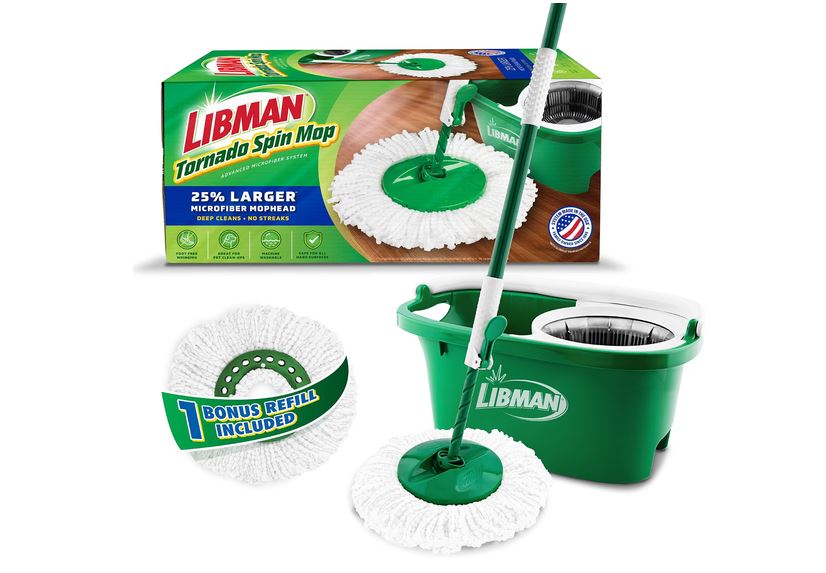
The Libman Tornado Spin Mop System is a traditional mop-and-bucket system with a modern twist: instead of squeezing a wet mop by hand, you use the mop’s handle and spinning wringer to remove excess water from a large microfiber head.
That simple design is the main reason to consider it.
Libman equips the Tornado with a large, machine-washable microfiber mop head, a heavy-duty bucket and a spinning chamber designed to remove water and dirt. The manufacturer says you can push the handle down once for a damp mop and multiple times for a drier mop. It also describes the system as suitable for hard smooth surfaces including hardwood, tile, vinyl and linoleum.
But there is more to a mop than its feature list.
The Tornado has received strong customer feedback overall, yet some users have reported problems involving the handle, wringing mechanism, mop-head stability and drainage.
So is the Libman Tornado Spin Mop worth buying?
For someone who wants a large, absorbent microfiber mop with a hands-free wringing system for cleaning larger hard-floor areas, it is a compelling option. However, shoppers with very limited storage or those particularly concerned about long-term mechanical durability should consider its limitations before buying.
Libman Tornado Spin Mop at a Glance
| Feature | Libman Tornado Spin Mop |
|---|---|
| Product number | #1283 |
| Mop type | Spin mop and bucket system |
| Mop head | Large microfiber |
| Mop head | Machine washable |
| Wringing | Push-down spinning mechanism |
| Bucket | Heavy-duty |
| Bucket capacity | 2 gallons |
| Handle | Steel with impact-resistant lower section |
| Moisture control | Yes |
| Replacement head | #1284 |
| Electricity required | No |
| Batteries required | No |
| Suitable floors | Hardwood, tile, vinyl, linoleum and other hard smooth surfaces |
| Main strength | Large absorbent microfiber head |
| Main weakness | Bucket storage and some reported durability concerns |
| Best suited to | Larger cleaning jobs and whole-house mopping |
Libman says the Tornado’s 2-gallon bucket is designed to resist tipping and includes a pour spout, while its mop uses an extra-large microfiber head and a steel handle with an impact-resistant lower section.
What Is the Libman Tornado Spin Mop?
The Libman Tornado is an all-in-one mop and bucket system.
Its basic design consists of:
- a large microfiber mop head
- a mop handle
- a bucket
- a spinning wringing chamber
Unlike a conventional string mop, you don’t have to grab the wet mop head and twist it by hand.
Instead, the mop handle is used to operate the wringing mechanism.
Libman describes the system as having a large microfiber head designed to absorb and remove water efficiently, while the spinning chamber removes water and dirt from the mop head.
The result is a system aimed primarily at whole-floor cleaning rather than quick spot cleaning.
How Does the Libman Tornado Spin Mop Work?
The operating principle is fairly simple.
1. Fill the bucket
Add water to the bucket according to Libman’s instructions.
2. Wet the mop head
Place the microfiber head into the water.
3. Mop the floor
Use the large microfiber head to collect dirt and moisture.
4. Place the mop into the wringing chamber
Return the mop head to the spinning section of the bucket.
5. Unlock the handle
The handle mechanism needs to be positioned correctly before wringing.
6. Push the handle downward
The handle activates the spinning mechanism.
One push produces a relatively damp mop, while additional pushes remove more water.
Libman specifically explains that pressing the handle down once produces a damp mop and additional pushes make the mop progressively drier.
7. Continue cleaning
Repeat the process as the mop becomes dirty.
The concept is simple, but there is a small learning curve.
In a recent independent test, Today.com reported that once the reviewer understood how to unlock the lever and push the handle down correctly, the wringing process became easy to operate.
The Large Microfiber Mop Head
The mop head is one of the most important differences between the Tornado and some competing spin mops.
Libman describes it as a large microfiber mop head designed to absorb and remove more water so floors can dry faster.
That larger surface area has an obvious advantage:
You can cover more floor with each pass.
This becomes particularly useful when cleaning:
- kitchens
- living rooms
- hallways
- larger tile floors
- multiple rooms
- whole-house flooring
Libman’s own comparison material positions the Tornado as a system that holds more water and is intended for larger cleaning jobs, while its Wonder Mop is positioned more toward daily cleaning.
Is the Large Mop Head Actually Better?
Not necessarily for every user.
A large mop head can cover more area, but it can also feel less convenient in tight spaces.
For a large open kitchen floor:
larger head = advantage.
For cleaning around:
- chair legs
- narrow bathrooms
- furniture
- tight corners
a smaller mop head may be easier to maneuver.
That’s why I wouldn’t describe the Tornado’s large head as universally superior.
It is better suited to coverage and absorbency, while smaller mop heads can have an advantage in maneuverability.
How Well Does the Libman Tornado Clean?
The Tornado has performed well in recent independent testing.
Today.com’s 2026 test evaluated several mops and gave the Libman Tornado an overall average score of 4.68/5, with particularly strong results for setup, cleaning performance, absorbency and ease of use. The publication selected it as its editor’s pick in that test.
The test specifically praised:
- the quality of the mop head
- absorbency
- sturdy construction
- smooth wringing
- ease of installation
- dirt pickup
That is useful independent evidence because it goes beyond the manufacturer’s product specifications.
However, one test shouldn’t be treated as proof that the Tornado will outperform every competing mop in every household.
Cleaning results depend on:
- flooring
- type of dirt
- cleaning solution
- moisture level
- pressure
- mop technique
- how frequently the mop head is washed
Is the Libman Tornado Good for Hardwood Floors?
Libman states that the Tornado is safe for hardwood and other hard smooth surfaces.
The important word here is hardwood, not every possible wood floor.
If you have sealed hardwood, the ability to control how much water remains in the mop is useful.
Libman specifically recommends using the correct moisture level for different floor types, and its current 2026 usage guidance warns against leaving the mop too wet on moisture-sensitive floors such as hardwood and laminate.
Therefore:
The Tornado can be appropriate for sealed hardwood, but it should not be used as an excuse to flood a wood floor with water.
Always follow your flooring manufacturer’s cleaning instructions.
Is It Good for Laminate?
The Tornado can be used on laminate according to Libman’s current product and cleaning guidance.
But moisture control becomes especially important.
The useful feature here is that the wringer allows you to remove more water before mopping.
For laminate:
- Don’t saturate the mop unnecessarily.
- Use the appropriate cleaning solution.
- Avoid leaving standing water.
- Allow the floor to dry promptly.
The Tornado’s ability to adjust the mop’s moisture level is therefore more important than simply the fact that it is a microfiber mop.
What About Tile and Vinyl?
These are natural applications for a spin mop.
Libman lists tile and vinyl among the surfaces compatible with the Tornado.
The large microfiber head can be useful on larger tile floors because it covers more area per stroke.
For heavily textured tile or dirty grout, however, don’t expect a microfiber mop alone to replace a dedicated scrub brush.
The Tornado is primarily a floor-mopping system, not a specialized grout-cleaning machine.
The Wringing Mechanism
The Tornado uses a different approach from the foot-pedal system found on many O-Cedar spin mops.
Instead of pressing a pedal, the user pushes the mop handle down into the spinning chamber.
Libman calls this its wringing mechanism and says additional pushes make the mop progressively drier.
This has one interesting advantage:
your hands never need to touch the wet mop head.
It also gives you direct control over moisture.
Damp mop
One push.
Drier mop
Additional pushes.
This is particularly useful when moving between flooring types.
Is the Wringing System Easy to Use?
Once you understand the mechanism, it appears to be relatively straightforward.
A recent independent test reported a slight learning curve but found that the mechanism became effortless once the correct lever and pushing motion were understood.
However, customer feedback is not completely uniform.
Some users report excellent wringing performance.
Others have complained about the mechanism failing or becoming difficult to use.
For example, recent Walmart reviews include complaints about the drainage/wringing system failing after a few months, while Home Depot reviews include complaints about the handle mechanism.
That means the fairest conclusion is:
The wringing design is clever and effective when functioning correctly, but long-term mechanical durability deserves consideration.
Does the Tornado Separate Clean and Dirty Water?
No—not in the same way as a dual-water system such as the O-Cedar RinseClean.
The Tornado has a single 2-gallon bucket with a spinning chamber. Libman’s product information emphasizes water removal and dirt removal from the mop head rather than separate clean- and dirty-water reservoirs.
This is an important distinction.
If you are comparing the Tornado with the O-Cedar RinseClean:
RinseClean’s key advantage is separate clean and dirty water.
Tornado’s key advantage is its large absorbent microfiber head and simple spinning wringer.
Those are different approaches.
Libman Tornado vs O-Cedar EasyWring
This is one of the most useful comparisons for a potential buyer.
| Feature | Libman Tornado | O-Cedar EasyWring |
|---|---|---|
| Mop head | Large microfiber | Microfiber |
| Wringing | Push handle down | Foot pedal |
| Bucket | Single bucket | Single bucket |
| Clean/dirty water separation | No | No |
| Mop head washable | Yes | Yes |
| Moisture control | Yes | Yes |
| Hardwood use | Yes, sealed surfaces | Yes, sealed surfaces |
| Main strength | Large absorbent head | Foot-pedal wringing |
| Main consideration | Handle/wringing durability feedback | Mechanical components and bucket size |
| Best for | Larger cleaning jobs | General hard-floor cleaning |
The choice largely comes down to what you prefer:
larger mop coverage and handle-operated wringing
versus
foot-operated wringing and O-Cedar’s more established spin-mop ecosystem.
Libman Tornado vs O-Cedar RinseClean
The difference is even clearer here.
| Feature | Libman Tornado | O-Cedar RinseClean |
|---|---|---|
| Large microfiber head | Yes | No |
| Separate clean/dirty water | No | Yes |
| Spinning wringer | Yes | Yes |
| Foot pedal | No | Yes |
| Reusable microfiber | Yes | Yes |
| Best advantage | Absorbency and floor coverage | Water separation |
| Bucket complexity | Simpler | More complex |
| Best for | Larger routine cleaning | People prioritizing clean-water separation |
If you frequently mop large areas and care most about coverage and absorbency, Tornado has an interesting proposition.
If you care most about not rinsing your mop in dirty water, RinseClean’s design has a more direct advantage.
Libman Tornado Pros and Cons
Pros
Large microfiber head
The large head can cover more floor with each pass.
Strong absorbency
The microfiber head is designed to absorb water and remove it during wringing.
Hands-free wringing
You don’t need to squeeze the mop head manually.
Adjustable moisture
Additional pushes of the handle produce a drier mop.
Machine-washable head
The mop head can be washed and reused.
Replacement heads are available
Libman sells replacement head #1284.
Large bucket
The 2-gallon bucket is designed for larger cleaning jobs.
No batteries or electricity
It is completely manual.
Good independent test results
A recent Today.com test gave the system an overall 4.68/5.
Cons
Bucket takes up storage space
This is a full mop-and-bucket system rather than a compact spray mop.
No clean/dirty water separation
You don’t get the dual-water arrangement found in O-Cedar RinseClean.
Some users report handle problems
Recent Home Depot and Walmart reviews include reports of handle mechanisms breaking or failing to remain extended.
Some users report wringing/drainage problems
Recent customer reviews include complaints about the drainage system and wringing mechanism.
Learning curve
The handle-operated wringer isn’t immediately intuitive to everyone.
Large head isn’t ideal everywhere
Its size is useful for large floors but can be less convenient in tight spaces.
What Are Customers Saying About the Libman Tornado?
The overall customer picture is quite strong.
Walmart currently displays 4.6/5 from 2,902 ratings, with 78% five-star ratings and 4% one-star ratings on the current listing.
Home Depot currently shows 4.7/5 from 2,114 reviews, with 97% recommending the product.
These are strong signals, but averages don’t tell the entire story.
Positive customer themes
Customers commonly praise:
- cleaning performance
- ease of use
- absorbency
- spinning/wringing
- machine-washable head
- bucket design
- ability to cover larger areas
Walmart’s current review summary highlights simple operation, effective floor cleaning, easy spinning, washable mop heads, portability and bucket design.
Negative customer themes
The negative reviews are particularly useful because they identify potential ownership problems.
They include:
- handle breaking
- handle not staying extended
- drainage problems
- mop head flipping
- concerns about floor contact
- difficulty with the wringer
- durability concerns
One Walmart customer reported that the mop stopped locking in its extended position after about two months of use, while another reported repeated problems with the mechanism used to squeeze the mop.
Home Depot also contains a recent review from a customer who said the handle’s twisting mechanism broke after several uses.
These are individual reports and shouldn’t be interpreted as evidence that all Tornado systems fail.
But they are legitimate considerations when evaluating long-term ownership.
Is the Libman Tornado Durable?
This is probably the hardest question to answer from the available evidence.
The manufacturer describes the lower handle as precision-molded and impact-resistant, and its product information emphasizes a steel handle.
That suggests durability was an explicit part of the design.
However, some current customer reviews report failures involving the handle or wringing/drainage mechanism.
The appropriate conclusion isn’t:
“The Tornado breaks easily.”
There isn’t enough evidence to make that blanket statement.
Nor would it be appropriate to say:
“The Tornado is extremely durable.”
The customer evidence doesn’t justify that either.
A more defensible conclusion is:
The Tornado has a sturdy-feeling design and strong overall customer ratings, but mechanical durability is one area where some owners have reported problems. Buyers should therefore pay attention to Libman’s warranty/support and the retailer’s return policy.
How to Wash the Libman Tornado Mop Head
The microfiber head is designed to be machine washable.
Libman states that its major microfiber mop heads can be washed repeatedly, and replacement heads are available.
A sensible maintenance routine is:
- Remove the mop head.
- Rinse away loose dirt.
- Machine-wash according to Libman’s instructions.
- Avoid products that can damage microfiber performance.
- Allow the head to dry completely.
- Reattach before the next cleaning session.
Don’t leave a damp mop head trapped inside a closed bucket.
Proper drying is part of maintaining the cleaning equipment.
How Often Should You Replace the Tornado Mop Head?
Libman lists replacement mop head #1284 for the Tornado Spin Mop System.
The replacement schedule should depend on:
- frequency of use
- type of dirt
- washing frequency
- microfiber condition
- loss of absorbency
- visible wear
A mop head that has become worn, badly stained or noticeably less effective should be replaced rather than used indefinitely.
Libman’s current educational material suggests approximately three months for regular use for its Tornado system, although actual replacement intervals will vary with usage.
Is the Tornado Good for Large Homes?
This is one situation where the product makes particular sense.
The large microfiber head and 2-gallon bucket are oriented toward larger cleaning jobs. Libman itself describes the Tornado as suitable for whole-house cleaning and larger floors.
For a large home with:
- tile
- vinyl
- laminate
- sealed hardwood
the ability to cover more area per pass can save effort.
But there is a tradeoff:
larger cleaning equipment also means more equipment to store.
Is the Tornado Good for Apartments?
It depends on the apartment.
The mop itself can work well in an apartment, particularly if you have several hard floors.
The bigger question is storage.
A 2-gallon bucket plus mop takes considerably more space than a flat or spray mop.
If your cleaning closet is tiny, that could become irritating.
If you have a laundry area or utility closet with sufficient space, the storage issue becomes much less important.
Is the Libman Tornado Good for Pet Owners?
It can be useful in homes with pets because the large microfiber head is designed to collect dirt, dust and hair.
The larger head can also be useful for cleaning larger areas where pets regularly walk.
However, the Tornado does not separate clean and dirty water.
If that feature is particularly important for your household, a dual-water system such as O-Cedar RinseClean may deserve comparison.
Who Should Buy the Libman Tornado Spin Mop?
The Tornado is particularly worth considering if you:
- clean multiple rooms
- have large hard-floor areas
- want a large microfiber mop head
- want hands-free wringing
- want adjustable moisture
- prefer reusable cleaning heads
- don’t want batteries or electricity
- have enough space to store a bucket
- regularly clean tile, vinyl or sealed hardwood
The system’s biggest strength is coverage combined with absorbency.
Who Shouldn’t Buy the Libman Tornado?
Consider another mop if:
You have very limited storage
A spray mop or compact flat mop may fit your space better.
You specifically want clean and dirty water separated
The Tornado doesn’t provide that type of two-tank system.
You only perform quick daily cleanups
A bucket-based mop may be more equipment than you need.
You need a very small mop head
The Tornado’s large head is better suited to coverage than tight spaces.
You are particularly concerned about mechanical components
Although overall customer satisfaction is strong, recent reviews include complaints about handle and wringer-related failures.
Libman Tornado vs Traditional Mop
| Feature | Libman Tornado | Traditional String Mop |
|---|---|---|
| Microfiber | Yes | Usually cotton/string |
| Wringing | Spinning mechanism | Manual or bucket wringer |
| Hands-free wringing | Yes | Depends |
| Moisture control | Strong | Variable |
| Reusable head | Yes | Usually |
| Floor coverage | Large | Variable |
| Bucket included | Yes | Depends |
| Electricity | No | No |
| Storage | Larger | Variable |
The Tornado’s biggest improvement over a basic mop is the combination of microfiber + large head + controlled wringing.
Is the Libman Tornado Spin Mop Worth It?
For the right user, the design makes a lot of sense.
The large microfiber head is genuinely useful for larger floors. The wringer removes the need to manually squeeze the mop. The moisture can be adjusted, and the mop head is reusable.
Recent independent testing also supports its practical strengths. Today.com’s 2026 test found the Tornado easy to set up and use, with strong cleaning performance, absorbency and wringing.
But there are legitimate limitations.
It takes up more space than a spray mop.
It doesn’t separate clean and dirty water.
And although its overall retailer ratings are strong, there are enough recent complaints about the handle and wringing/drainage components that durability shouldn’t simply be assumed.
Final Verdict
The Libman Tornado Spin Mop System is best understood as a large-floor, high-absorbency spin mop rather than a compact everyday spot-cleaning tool.
Its large microfiber head is one of its strongest characteristics, particularly for kitchens, hallways, tile floors and larger areas. The handle-operated wringer gives you control over moisture without requiring you to touch a wet mop head. Libman also provides replacement heads, making the system reusable rather than disposable.
The product’s overall customer reception is strong, and recent independent testing has also produced favorable results.
However, a genuinely independent review shouldn’t ignore the negative evidence.
Some customers have reported problems with the handle mechanism, wringing/drainage system and mop-head stability. Those reports don’t prove that the product is inherently unreliable, but they are worth considering before purchase.
Bottom line
The Libman Tornado is worth considering if you want a large, absorbent microfiber spin mop for cleaning multiple rooms or larger hard-floor areas.
Its strongest advantages are:
large microfiber coverage + strong absorbency + adjustable wringing + reusable head.
Its main tradeoffs are:
bucket storage + no clean/dirty water separation + some reported mechanical durability issues.
If clean-water separation is your priority, compare it with the O-Cedar RinseClean.
If hands-free foot-pedal wringing is more important, compare it with the O-Cedar EasyWring.
If you want maximum floor coverage and a large absorbent microfiber head, the Libman Tornado deserves serious consideration.
Check the current price, replacement-head availability and retailer return policy before buying.